
On a rain-soaked road beside Jantar Mantar, an eighteenth-century astronomical observatory built by the Mughal ruler Maharaja Jai Singh II in the heart of New Delhi, a grand peaceful protest is taking place. The protest, which began as an internet joke exposing the failure of the education system, is now confronting the world’s largest democracy with uncomfortable questions: How did a joke become a national security threat? Why did satire invite intelligence agencies while unemployment invited little more than official silence?
The protest by the Cockroach Janta Party is in its fifth week. Protesters remain at Jantar Mantar, New Delhi’s designated site for public demonstrations, even after Delhi Police declined to extend the original permission for the sit-in.
While the police regard the continuing occupation as unauthorised, the protesters have refused to disperse, vowing to remain until their demands are addressed.
Among the protesters are members of the All-India Students’ Association (AISA), one of India’s largest left-wing student organisations, who are on an indefinite hunger strike, battling through the monsoon rains. Two fasting scholars from Jawaharlal Nehru University (JNU), India’s premier public university for the social sciences and a long-standing centre of student activism, have already been hospitalised, one after her blood sugar collapsed and another on the 19th day of his fast.
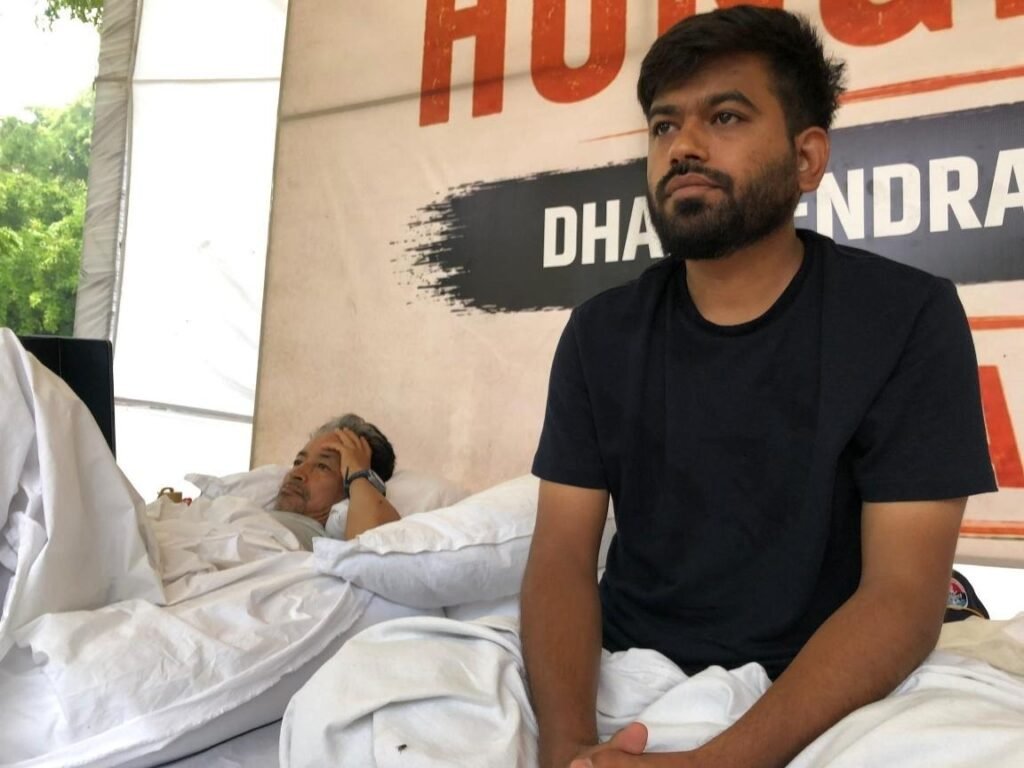
A prominent figure in the protest is Sonam Wangchuk, the engineer, education reformer and climate activist from the Himalayan region of Ladakh, whose campaign to protect the fragile ecology and constitutional rights of his home has made him one of India’s best-known environmental campaigners. Fasting alongside the students, he has lost more than seven kilograms so far.
They call themselves cockroaches because the Chief Justice of India satirically called them that first. On 15 May, during a Supreme Court hearing, Chief Justice Surya Kant said there were “youngsters, like cockroaches, who don’t get any employment and don’t have any place in the profession. Some of them become media, some of them become social media, RTI activists and other activists, and they start attacking everyone.”
He later clarified that he had meant only holders of fraudulent degrees, and called India’s youth “the pillars of a developed India.” The clarification arrived too late. The insult had already found its audience: a generation living inside the statistics it dismissed.
The next day, Abhijeet Dipke, a Boston University graduate, posted a question on X: “What if all cockroaches came together?” Within twenty-four hours, he had built a website and a manifesto for the Cockroach Janata Party , a satirical jab at the ruling Hindu right-wing Bharatiya Janata Party. Some of the qualifications for CJP’s membership included being unemployed, lazy, and chronically online.
Within three days, its Instagram account had three million followers; within a month, twenty-two million, more than double the BJP’s own.
Here is what the episode reveals: when a government treats satire by unemployed young people as a matter of national security, the classification tells you almost nothing about the movement and almost everything about the state.
The Only Place Left to Protest
The “cockroaches” proudly walked into the one square where the state still permits them to voice their protest. Jantar Mantar is Delhi’s designated protest site for dissent by official designation, and since 20 June it has been the CJP’s fallback platform.
The trigger was an education system in open collapse: The National Eligibility cum Entrance Test (NEET) — India’s unified entrance exam for medical and dental schools — was cancelled over paper leaks days after more than two million aspirants sat it, competing for fewer than 130,000 seats.
Several students died by suicide after the cancellation. India produces over eight million graduates a year; unemployment among them runs at 29.1 per cent, nine times the rate for those who never attended school.
The movement’s central demand is the resignation of Education Minister Dharmendra Pradhan; its “exam manifesto” demands compensation of 10,000 rupees per candidate when a paper leaks, transparent testing, physical evaluation of answer sheets, and an independent audit of the private agencies contracted to conduct examinations.
Four weeks in, the government’s only visible response has been the transfer of two bureaucrats. Pradhan remains in office. But Pradhan’s resignation is not simply about accountability for a failed exam. It is a demand for institutional reckoning. For millions of students, the NEET cancellation was not an administrative glitch; it was proof that the system they had sacrificed years to compete within was fundamentally broken and that their sacrifice meant nothing to those managing it. Pradhan, as minister, is the symbol of that indifference. His removal would signal that when the state harms its youth through negligence or incompetence, there are consequences. Without it, the message is clear: the minister sleeps while students burn.
Beyond the individual, protesters are demanding something larger: that India’s education system acknowledge it has failed and commit to reform. The exam manifesto’s specific demands for compensation, transparency, physical answer sheet evaluation, and independent audits of private testing agencies are not about punishment. They are about rebuilding trust in institutions that have lost it.
Testimonies from the ground
Md Shaukat Khan, a 22-year-old who took an overnight train from Moradabad, UP, for the CJP’s first Delhi rally, told The Secularist: “I followed them on Instagram for fun. But there is a chance that we can actually get the minister to resign.”
Mohammad Aftab, a 28-year-old gig worker who skipped a day’s wages to attend in a cockroach mask, told the same outlet: “I could not go to school, but there are millions of students who did not sleep at night for their exams to make a life for themselves. It is our duty to stand up with them.”
Among the hunger strikers is Neha Singh, the national president of AISA and a doctoral candidate, who has anchored the fast. “We do not have a definite deadline for how long we want to continue our hunger strike,” she told The Secularist.
Tanuj Gaurav, an AISA activist and first-generation scholar from Gaya, Bihar, is pursuing research in International Studies at Jawaharlal Nehru University (JNU), said that the mechanism that the CJP ban has now made visible to millions: “The moment you raise a question, you’re linked to the enemy. After that, nobody wants to ask questions anymore.” That is precisely what a confidential national-security order does to a joke: it converts a question into an accusation, and laughter into liability.
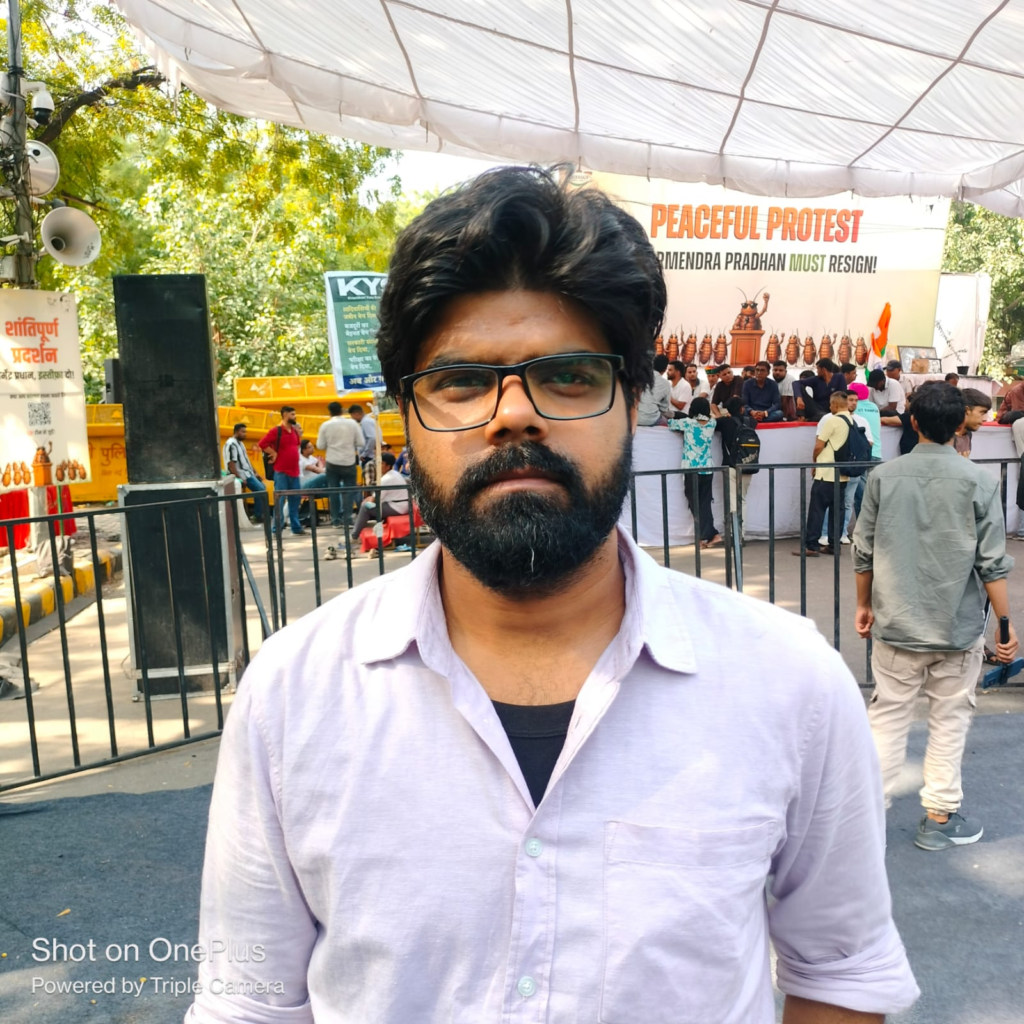
The rampant spread of the cockroaches
There is a dark comedy in how this unfolded. Chief Justice’s snide remark meant to dismiss a generation ended up giving it the perfect symbol. Of all the creatures to choose, it was the cockroach, the one thing everyone tries to get rid of, yet somehow never can.
He chose the one creature evolution built to outlast every attempt to stamp it out. It led to an unprecedented online movement which has now found an offline stage in the national capital. Yet the movement’s resilience was never dependent on any platform. It survived by constantly changing form from hashtags to human chains, from Instagram posts to the streets of Jantar Mantar, and from viral memes to hunger strikes.
Coming up next now is a peaceful march from Jantar Mantar to Parliament on 20 July, the opening day of the Parliament’s monsoon session. “We are moving closer to the government,” the organisers say, “so that they can hear us.”
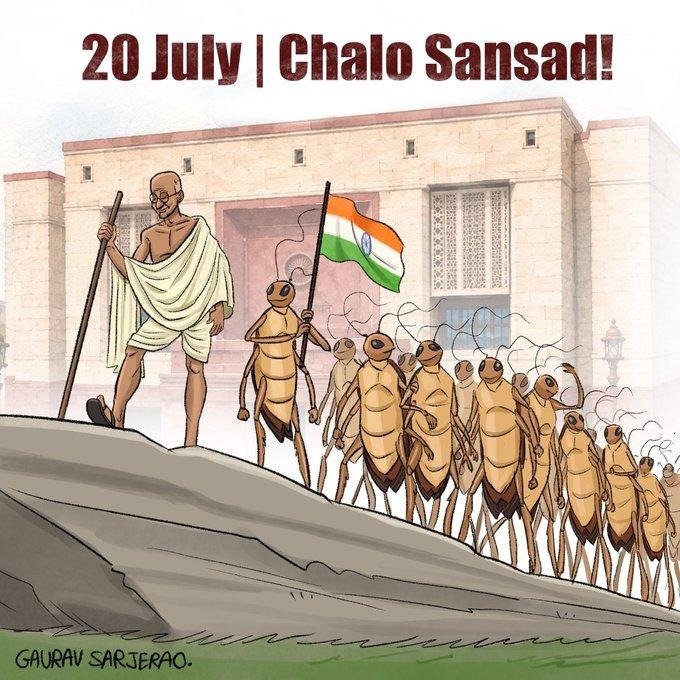
The July 20 march to Parliament would be a test. It moves the protest from the designated protest zone to the seat of government itself. If police stop them, it becomes a story of the state using force against fasting students. If the government allows it, it becomes a story of a movement that made the state listen. Either way, the message is the same: Pradhan cannot stay. The only question left is whether he resigns because of protest pressure or political survival.
The Cockroach Janta Party did not expose a weakness in India’s young people. It exposed a weakness in the Indian state and its education system. A government confident in its own legitimacy does not treat a joke as a national security threat. It answers criticism instead of trying to silence it. When a state cannot tell the difference between satire and a real threat, it says more about its own insecurity than the people wearing the funny masks.
This article is republished from The Secularist under a Creative Commons license. Read the original article.

Gaurav Kumar
Gaurav Kumar is a journalist based in New Delhi. While his primary beat is strategic affairs, he also reports on politics, governance, and stories that illuminate broader social and institutional change.

