
We need your support to keep the secularist going


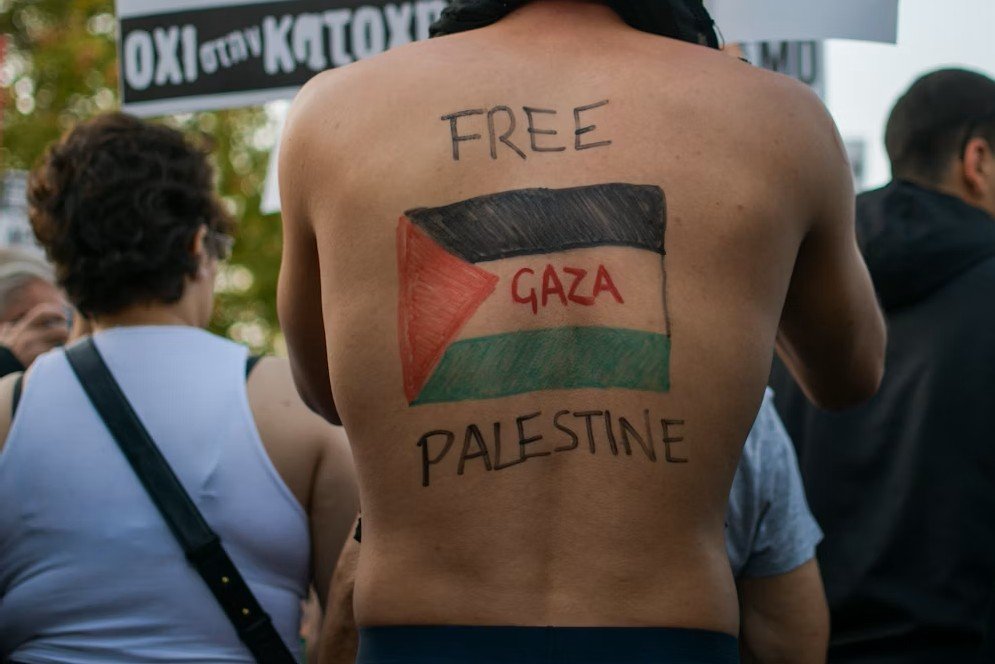
Jumping from the top of a truck, Gazan journalist Anas Al‑Sharif landed in the arms of his best friend, Saleh Al‑Ja’farawi, with a joy that felt almost borrowed from another world, brief, bright, and impossibly alive amid a landscape cratered by warplanes. In the shared grin between them, you can sense their camaraderie and passion for the profession they shared: reporting side by side, filming each other in bombed‑out streets, whispering encouragement before live hits, stitching truth together with battery‑powered cameras and half‑charged phones. The clip of that embrace went viral. Then it became a memorial. Days after a ceasefire was announced in October 2025, Al‑Ja’farawi was killed. His father told the Committee to Protect Journalists (CPJ) that his killers belonged to a Palestinian armed militia widely understood to be backed by Israeli forces.
Both Al‑Sharif and Al‑Ja’farawi had been reportedly put on a “red notice” list by Israeli authorities because of their coverage of the war. Looking back, these steps feel like shadows cast before the strike. Within months, two men who had been covering the war were gone, their spotlights on the deadly conflict now extinguished in a place that needs as much light as it can get.
According to the latest figures from the Committee to Protect Journalists (CPJ), Israel has killed 259 media workers in the conflict since the Hamas terror attack on October 7, 2023, 210 of them Palestinian journalists inside Gaza. An additional 11 Lebanese reporters were killed in their home country in this conflict, while two Israeli journalists have been killed by Hamas, and one Palestinian media worker was killed by an armed group in Gaza. This number dwarfs the death toll for journalists for all other wars going back to 1992 — and is a figure so staggering that it reframes journalism itself as a battleground. In Gaza, being a reporter is not just choosing a profession; it is also a potentially life-and-death decision.
Under Article 79 of Additional Protocol I to the Geneva Conventions (1977), journalists on “dangerous professional missions in armed conflict” must be treated as civilians. It is one of the clearest protections in international law. Yet in Gaza, their cameras and press vests have become targets. Based on its analysis through mid-March 2026, CPJ claims that “at least 64 journalists and media workers were directly targeted and killed by Israeli forces in direct reprisal for their work.” Last September, Reporters Without Borders (RSF) submitted its fifth ICC complaint documenting Israel’s deliberate targeting of Palestinian journalists. These five complaints are built on eyewitness accounts, timelines of killings, video evidence, and the testimonies of families who buried reporters still wearing press insignia on their chests.
For its part, the Israeli military has repeatedly denied targeting journalists, telling CPJ that the media workers killed were “not identified” or that their status as noncombatants was “unclear” — and that any claims to the contrary are not credible because of Israel’s advanced capabilities in military surveillance, intelligence, and targeting.
“With such technology, there is no plausible deniability about who is being targeted,” countered CPJ Regional Director Sara Qudah. “Since October 7, 2023, Palestinian journalists have been slaughtered with impunity, while the world watches. This is a direct, unprecedented assault on press freedom.”
Maha Nassar, an associate professor in Middle Eastern Studies at the University of Arizona, has written that evidence of Israel’s anti-press tactics stretches back decades. She argues that this trend began in 1967 with surveillance of Palestinian publications, and continued through the early 2000s with newsroom raids and the killing of individual journalists, and then escalated sharply after the Hamas terrorist attack in October 2023.
window.addEventListener(“message”,function(a){if(void 0!==a.data[“datawrapper-height”]){var e=document.querySelectorAll(“iframe”);for(var t in a.data[“datawrapper-height”])for(var r,i=0;r=e[i];i++)if(r.contentWindow===a.source){var d=a.data[“datawrapper-height”][t]+”px”;r.style.height=d}}});
When Journalists Are the Only Witnesses Left
Since Israel sealed the Gaza Strip in early October 2023 and banned foreign journalists from entering, the world has slowly lost visibility on what’s happening on the ground. Reporting became an exercise in stitching together fragments of sound and image: voice notes recorded over explosions, WhatsApp messages from basements, and shaky videos captured by people unsure they would survive the next day, hour, or minute. The strip felt like an island cut off from the world, except for one remaining tether, the local journalists who refused to stop filming and investigating.
Hind Hassan, the multi‑Emmy Award‑winning correspondent and documentary filmmaker, described the dependence on reporters still inside Gaza. She and her team “work with journalists who are on the ground, who verify information for us, who collect testimony… who go and film in locations” too inaccessible or deadly for outsiders.
Without them, she said, the voices of Palestinians caught up in the war would be silent. “We wouldn’t be able to report on Gaza if it weren’t for the information that they were providing and the documentation that they were providing us,” she explained.
For Starving Gaza, Al Jazeera’s investigation into Israel’s “man‑made famine,” these journalists became the eyes and ears of the world. Much of the documentary was filmed inside Kamal Adwan Hospital in Gaza’s Beit Lahia, where malnourished children arrived pale and limp. Every frame of footage depended on someone who risked being bombed for holding a camera.
“When it became impossible to access the field in Gaza and Al‑Haq lost the ability to collect evidence from the ground, local journalists in Gaza stepped in and began working side by side with our researchers,” said Shawan Jabarin, general director of Al‑Haq, a Palestinian human rights NGO founded in 1979.
But stepping in meant stepping into the crosshairs.
“Israel’s targeting and killing of journalists undermines accountability reporting because it stops information from getting out,” Hassan explained. “They also dehumanize the journalists who are there to try and undermine those who are witnessing the war crimes.”
Al-Haq’s Jabarin pushed further: “In my view, the targeting of journalists fits within a framework of genocide… It aims to annihilate not just people but also the narrative.”
Documenting Crimes No One Else Could Reach
Al‑Haq partnered with Forensic Architecture, one of the world’s leading investigative research groups, to examine potential war crimes in several recent stories about the war in Gaza. These investigations relied on satellite images, witness testimonies, timestamps, and, most significantly, the raw footage captured by Palestinian journalists moments after an airstrike.
“Some of those journalists did not live long enough to see their contributions shape legal cases,” Jabarin noted. Among them was Hasan Esleih, who was killed by an Israeli airstrike on Al‑Shifa Hospital while he was receiving treatment for wounds sustained in a prior attack. “His videos, however, continue to be cited in legal filings around the world.”
Forensic Architecture’s priority was to protect its sources from retaliation. Journalists shared their material, and researchers turned it into 3D reconstructions, synchronized timelines, and geolocated analyses, transforming fragments of chaos into evidence.
At GIJC25 in Malaysia, Forensic Architecture senior researcher Jumana Bawazir said that the loss of journalists documenting possible war crimes in Gaza weakens accountability efforts and undermines collective attempts to hold Israel accountable. “If it is not captured by a journalist, we can’t analyze it,” she said.
She also cautioned that forensic investigations move more slowly than the violence they document. Legal accountability, she noted, unfolds over years, while the destruction continues in real time. “There is a lag between documentation and justice,” she pointed out.
Gaza‑based journalist Jaber Badwan described the constant pressure he faces: “Many journalists, production companies, and channels ask me for videos and information directly from the field because they do not have access to Gaza.”
Every request is a reminder that the outside world is blind. Every reply is an act of resistance.
“Sure, there is fear,” he admitted. “But our determination is even greater. We know we could be targeted at any time, but our message must get through.”
Potentially deadly incidents have been present in Badwan’s journalistic journey while documenting Israeli atrocities in the Strip. He recalled one of the most harrowing moments doing his job: “I was planning to produce a report about the exploitation of some agricultural lands for local production at a time when no food was entering Gaza at all. The area I went to film was near Salah al-Din Road. As soon as I arrived, a quadcopter drone opened fire on me. Thank God I wasn’t hit by any bullets. I ran, and the farmers ran too. We hid in a small room where they keep their belongings and stayed there for about an hour to an hour-and-a-half. We left without filming anything.”
Remote Eyes, Fragmented Truth
Visual investigator Jake Golden works with satellite imagery, drone footage, and photogrammetry. But even he admits the limits of working from a distance.
“If there were Western reporters, then maybe they’d be slightly safer because maybe they wouldn’t be as targeted,” he said. The truth in his words hangs heavy. Some passports appear to be bulletproof; others are not.
Golden attempted to continue the work of drone operator Abdallah al‑Hajj, who had provided footage to UNRWA, after al‑Hajj was maimed in an Israeli airstrike. But Golden admits satellite images “don’t give you a full picture.”
They cannot show the tremor in someone’s hand as they dial for help, he explained. They cannot capture the dust in the air after a missile strike, or the way a mother’s voice breaks when identifying her child.
Breaking news alerts on Telegram, unstable livestreams, and hurried WhatsApp messages became the only threads outside investigators could pull on. From those strands, they built timelines, reconstructed events, and searched for patterns in destruction.
Ihsan Adel, head of the human rights nonprofit Law for Palestine, explained: “The lack of access has made things very tough. No one on the ground can properly document.”
Yet Adel noted that journalists’ work has been accepted as evidence in legal cases filed by Palestine. “Much of today’s human rights work, especially concerning Gaza, relies on these sources,” he pointed out. “Due to the lack of access for international organizations, this reliance is even stronger.”
Starting From Minus Five
In other conflict zones like Ukraine and Iraq, journalists have faced risk but still had mobility. They could often get physical access to a bombed site after a battle, interview survivors, or meet eyewitnesses face‑to‑face. Golden recalled collaborating with Ukrainian farmers and freelancers while reporting on Russia’s theft of grain shipments.
The war in Gaza has allowed none of this.
“Starting from minus five, that’s where journalists in Gaza,” said Raji Abdul Salam of The Reckoning Project, a group established after Russia invaded Ukraine that seeks to train and equip local researchers and journalists in documenting potential war crimes for future accountability. “Creating a political will is tough. Journalists in Gaza show remarkable integrity and credibility. Because of this, they face serious targeting.”
Hind Hassan described a second kind of destruction: erasing evidence by striking the same sites repeatedly. “That evidence is lost,” she said. “It becomes impossible to go on the ground and verify.”
There is a purpose behind this, Abdul Salam claimed. “Silencing journalists is a strategy. It controls the narrative, spreads misinformation, and blocks the truth,” he pointed out. “When you kill journalists, you’re not just taking lives; you’re breaking the link between raw evidence and proof.”
In August 2025, RSF launched a global campaign warning that Israel’s killing of journalists meant “there will soon be no one left to keep you informed.” Over 200 media outlets participated, blacking out front pages and broadcasting moments of silence.
Among them was the Lebanese daily L’Orient‑Le Jour. Reporter Ghadir Hamadi, a reporter with the site, hailed the bravery of those who have reported — and continue to report — from inside the war-torn area, even during a ceasefire where more reporters have been killed. “Gazan journalists are doing a wonderful job amid everything,” he said, “insisting on access for international journalists should not undermine or discredit the work Palestinian journalists have been doing and risking their lives for.”
 Majdoleen Hasan is GIJN’s Arabic editor and a three-time award-winning journalist with more than a decade of experience. She has worked with local and international media organizations, including Global Integrity, 100Reporters, and the Arab Reporters for Investigative Journalism network. She was the director of an investigative journalism unit in Jordan and was the first Jordanian citizen to file a case against the Jordanian government for denying her the right to access public information according to an access to information law. Hasan has an MA in political science and a BA in journalism.
Wadih Sabbagh is a Lebanese journalist who spent years covering and researching conflicts in Lebanon, Syria, and Palestine. Editor’s Note: Wadih Sabbagh is a stand-in for the co-author’s real name, which we are withholding for security reasons.
This article first appeared on Global Investigative Journalism Network and is republished here under a Creative Commons license.
Majdolin Hasan
Arabic Editor