
We need your support to keep the secularist going


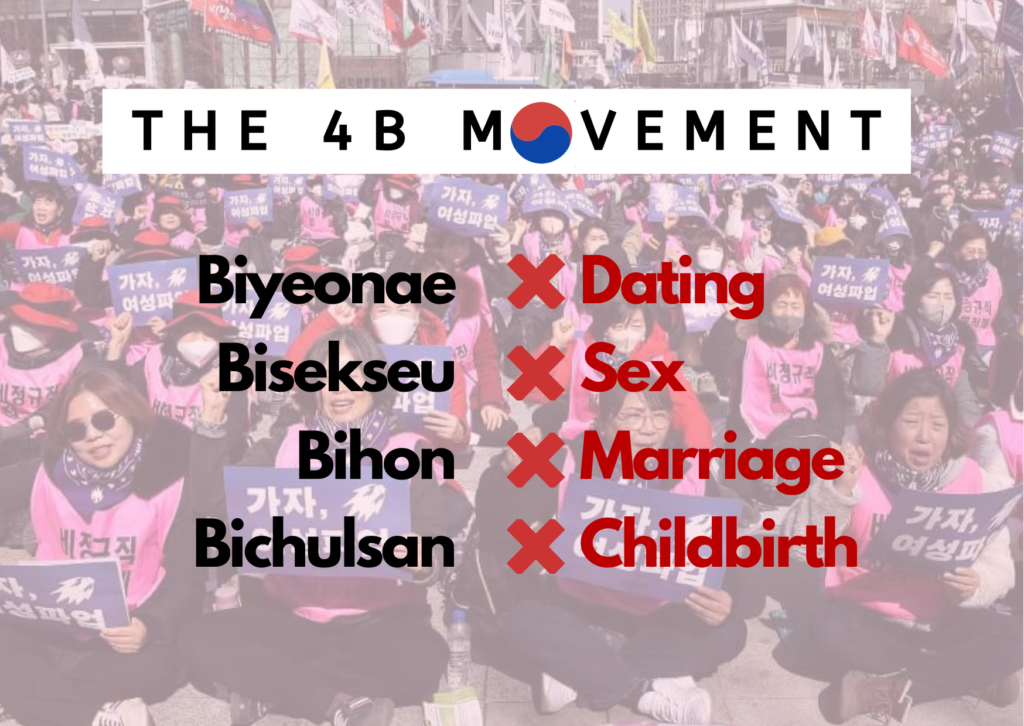
South Korea has the lowest fertility rate in the world – 0.72 births per woman in 2023, with some projections for 2025 going as low as 0.68. This is far below the 2.1 replacement level needed to maintain a stable population.
This did not happen overnight, and it certainly did not happen in isolation.
For years, South Korea has had the largest gender pay gap in the Organisation for Economic Co-operation and Development (OECD). Women face rigid workplace hierarchies, long work hours, limited childcare infrastructure, and strong expectations around marriage and domestic labour. Against that backdrop, beginning around 2017–2018, feminist online communities such as Megalia and WOMAD began popularising what came to be known as the 4B movement.
The 4 B’s stand for 4 refusals, namely:
- Biyeonae — no dating
- Bisekseu — no sex
- Bihon — no marriage
- Bichulsan — no childbirth4B
4B wasn’t a formal organisation or a registered group. It was a decentralised, voluntary refusal by the Korean women who no longer wanted to participate in a system that demanded their labour in the workplace and their unpaid care at home, while offering little in return.
While 4B is specific to South Korea, the pressures beneath it are not.
In Japan, declining marriage rates and the rise of so-called “herbivore men” reflect a quiet step away from traditional expectations around masculinity, marriage, and family life. In China, the term “leftover women” was used to shame educated women who remained unmarried past their late twenties. Many have responded not by rushing into marriage, but by choosing independence and financial stability on their own terms.
In India, the withdrawal is quieter: delayed marriage, choosing not to have children, or stepping back from paid work rather than publicly declaring refusal.
The language differs. The pattern does not.
The dominant narrative around the 4B movement says women are being extreme, overreacting, and punishing men.
But when I look at it through the lens of motherhood and care work, I don’t see extremism. I see women making rational decisions in an irrational system.
For decades, as women, we have romanticised motherhood. We have wrapped caregiving in poetry, calling it sacrifice, strength, love, and duty. But we have not talked about its cost, both, emotional and economic.
In India, an estimated 73% of women drop out of the workforce after childbirth, according to research by the Genpact Centre for Women’s Leadership at Ashoka University. A 2024 audit study by researchers affiliated with Ashoka University’s Centre for Economic Data and Analysis found that mothers with career breaks receive 49% fewer callbacks than comparable candidates. Only a small fraction of returning mothers move into leadership roles.
At the same time, government estimates place the value of women’s unpaid domestic and care work at 15–17% of GDP. A multi-trillion-rupee economy rests on labour that is neither paid nor protected.
Globally, the pattern is similar. According to the International Labour Organisation, women perform 76.2% of total unpaid care work, more than three times as many hours as men.
We call it love.
We call it sacrifice.
But economically, it is infrastructure.
The entire formal economy stands on this invisible backbone of cooking, cleaning, child‑rearing, elder care, and emotional labour.
We also rarely talk about the physical toll. Chronic caregiving stress, anxiety, autoimmune conditions, and cardiovascular risk in women, especially in contexts where support and redistribution of care are minimal.
We have not prepared anyone – not women, not men, not organisations- for what it actually takes to become a mother.
So when women look at this data, when they look at their mothers, grandmothers and when they see how motherhood means renegotiating your time, your income, your identity, your sleep, your body, your ambitions, all at once, with minimal support and maximum judgement, of course, they are choosing not to step into motherhood.
This is not rebellion. This is self‑preservation.
Morgan Stanley projects that by 2030, 45% of U.S. women aged 25-44 will be single and childless. This is not a preference. It is economics: motherhood penalties, rising childcare costs, and the pursuit of financial independence.
The current generation has the language, the data, and finally the permission to ask why things are the way they are. And they are not accepting “this is how it’s always been” as an answer.
The 4B movement is a symptom – a symptom of a system that still assumes care will be done quietly, for free, mostly by women. A system shaped by gender norms, workplace bias, unequal domestic labour, lack of childcare, and work cultures built around the “uninterrupted worker”: someone whose life is never disrupted by caregiving because someone else absorbs the cost.
That someone has always been women. And now, women are saying no.
If women are choosing not to have children, we do not need to convince them otherwise. We need to ask: What kind of world are we building in which motherhood feels like a penalty rather than a choice?
Then do the work – the real, structural, uncomfortable work- of changing it.
That means:
- Redistribute care across genders — normalise paternity leave, shared parenting, and equal domestic labour so caregiving is not coded female by default.
- Redesign workplaces – create flexibility without penalty, build transition support for caregiving phases, and stop measuring commitment by uninterrupted availability.
- Build real infrastructure – affordable childcare, eldercare systems, and care leave policies that treat caregiving as a universal life transition, not a women’s exception.
- Recognise unpaid labour – measure it, value it, and stop treating it as love that should not require support.
- Challenge bias – in hiring, promotion, and workplace culture- so that mothers are not penalised while fathers are rewarded for the same family status.
- Lastly but importantly, prepare people earlier – for partnership, for shared labour, for the economic and emotional realities of parenthood- instead of leaving those negotiations to happen under exhaustion and pressure.
This is the future of work.
And without addressing care, there is no sustainable workforce. And without structural change, refusal will not disappear, it will simply spread.

Natasha Virdi
Natasha Virdi is building Mother the Mother Movement (MTMM), examining care work as economic infrastructure and workplace design. She brings a systems lens to unpaid labour, motherhood penalties, and structural change. She presented at the IEEE Returning Mothers Conference and writes on gender and the care economy.
About the Writer

Natasha Virdi is building Mother the Mother Movement (MTMM), examining care work as economic infrastructure and workplace design. She brings a systems lens to unpaid labour, motherhood penalties, and structural change. She presented at the IEEE Returning Mothers Conference and writes on gender and the care economy.
Natasha Virdi writer